
AlecZander McNeal thought he knew a lot about his work as a chef before he enrolled in the Culinary Arts & Sustainable Foodways certificate program at Great Bay Community College. After recently completing the new 12-week program, McNeal now realizes how much he didn’t know.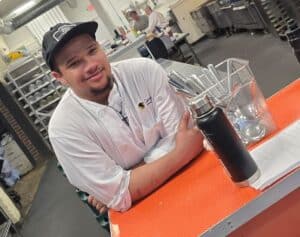
“The program was a blast. I learned a lot, and I loved the chef-instructors,” said McNeal, who works as a line cook at Tucker’s in Dover. “I worked on a line for five years before coming into the program. I guess I was a little arrogant. I thought, ‘How much can these people really teach me?’ Well, it was a big surprise. I learned way more than I thought I could learn.”
McNeal’s employer noticed the difference in his work right away. His knife skills were better, he managed his time more efficiently, and he eliminated some of the bad habits that had crept into his work, said Casey Schneider, Kitchen Manager at Tucker’s.
“His skills are far more refined now,” Schneider said. “Working with the chefs at Great Bay, his mentality has improved about how the kitchen works. It was refreshing to see what he was being taught. Zander has a much more professional outlook on how things should be done now.”
McNeal agrees with his manager’s assessment. “Before, my skills were there, they just weren’t polished to the point they needed to be,” he said. “But after going through the program at Great Bay, I have become a lot more meticulous about how I am doing things. I am more aware.”
Co-created by leading Portsmouth-area chefs and Great Bay to address a pressing industry need to recruit and train the next wave of talented culinary professionals, the Culinary Arts and Sustainable Foodways curriculum launched in February offering 180 hours of training, including externships at local establishments, over 12 weeks. The next session begins Sept. 8.
McNeal recommends the program to any current chef who wants to hone and improve their skills or an aspiring chef eager to join the industry. Beyond the kitchen work, McNeal learned about the industry as a whole.
Classroom topics include cold preparation, butchery, and bread baking and pastry techniques, among others. Outside of the kitchen, students visit local farms and fisheries to learn about the ecosystem of food distribution and the importance of sustainable agriculture.
Classes in nutrition illustrate how food affects bodies and how nutritious food has a direct and meaningful impact on both people and the planet. Complementary business classes focus on costing, labor management, recipe writing, purchasing and inventory management to provide a well-rounded education of culinary systems.
For five hours each week, students receive on-the-job training through externships at local establishments.
McNeal appreciated the encompassing curriculum. “We had a different unit each week, and it was very informative and interesting. We heard from people in the fishing industry, farmers, and others. The professors brought in a chocolate maker, a baker, and other people like that,” McNeal said. “We also learned a lot of skills. I was able to fine-tune a lot of my cuts, and I learned a lot of different techniques.”
For McNeal, a key component that allowed him to thrive in the program was the ability to take classes at night. “That meant I was able to work at my job where I am now and still go through the externship component of the program,” he said. “Great Bay was very responsive, which I appreciated.”
The Culinary Arts & Sustainable Foodways program evolved from conversations between Great Bay and three James Beard-nominated chefs and restaurateurs: Evan Mallett, chef and owner of Black Trumpet in Portsmouth; David Vargas, chef and owner of Vida Cantina and Ore Nell’s; and Jay McSharry, founder and CEO of JGroup Hospitality.
Students who complete the program receive a ServSafe Food Manager Certification, recognized by the National Restaurant Association. Successful students also receive a Culinary Arts Digital Credential that verifies accomplishments and documents skills. Like a digital resume, the credentials can be shared on social media and with potential employers.
Now that he has completed the program, McNeal is committed to the restaurant industry as a career. “I am a line cook now, but I am learning every aspect of the back-of-the-house operation, from dish prep to what goes on behind the scenes, like labor costs, food costs, and overall management,” he said. “I am excited about making this my career.”